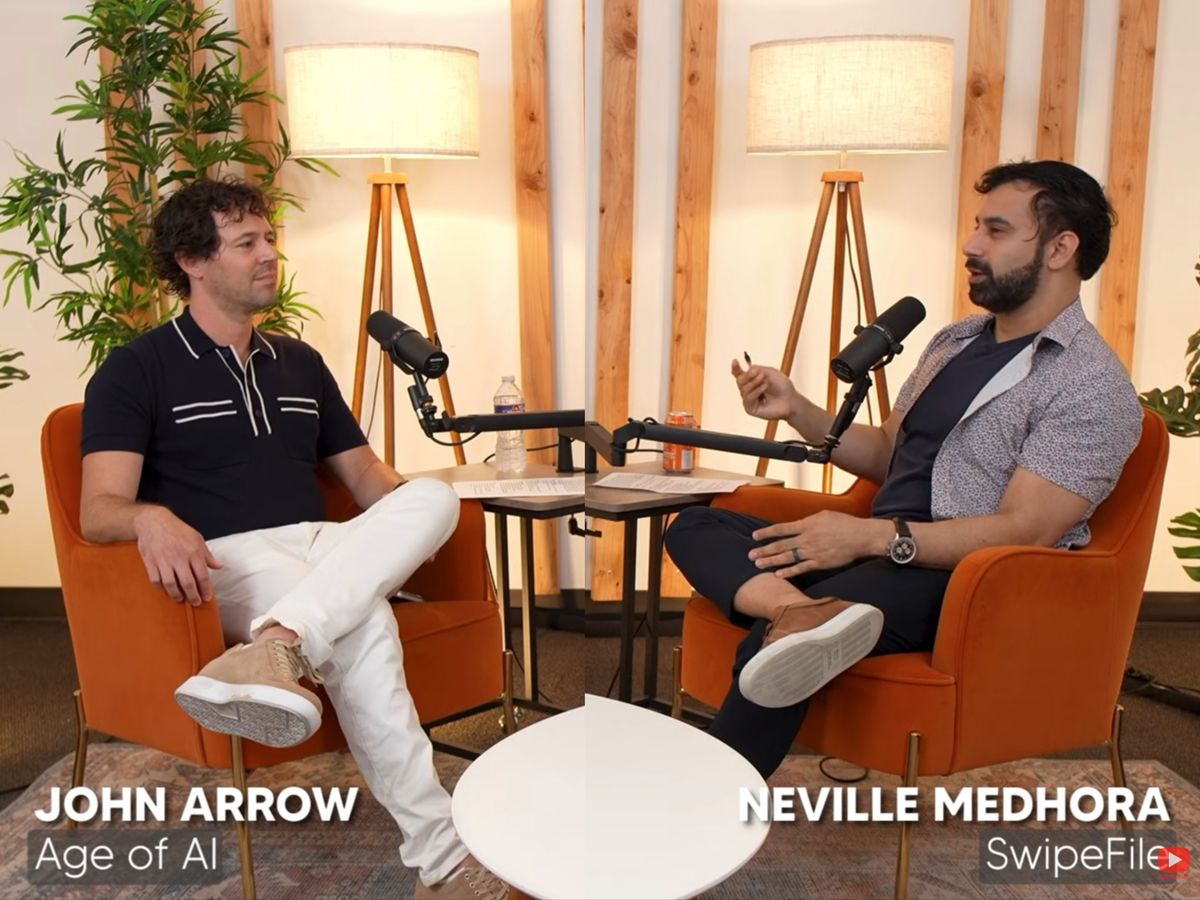
I recently had the pleasure of sitting down with Neville Medhora on the Kopywriting Kourse podcast to take a deep dive into my entrepreneurial journey.
From the early "rebel" days at UT Austin to scaling Mutual Mobile into a 400-person global agency, we covered a lot of ground regarding what it actually takes to build and sell a business.
In this post, I’ve broken down the key themes of our conversation, including the specific frameworks I use to think about the future of AI.
You’ll also find the full video of our chat and a complete transcript of the episode below.
Key Takeaways and Frameworks
We spent a significant amount of time discussing the evolution of technology and how to stay ahead of the curve as an entrepreneur. Some of the highlights include:
The "Outcome" vs. "Agent" Mindset: Why I believe the current "AI Agent" craze is just an intermediate step. The real value in the near future will be selling business outcomes rather than the software or the prompts used to get there.
High-ROI Creative Outreach: We discussed the "iPad Strategy"—a unique campaign where we sent physical tablets with pre-loaded presentations to Fortune 1000 CEOs to bypass gatekeepers and close million-dollar deals.
Scaling and Dominating a Niche: How we grew Mutual Mobile by strategically owning the SEO landscape for "iPhone App Development" during the original App Store boom.
The Perishability of Software: A look at why software is becoming a commodity and how founders must pivot toward proprietary data and service-based results to maintain a competitive moat.
Neville Medhora: Today we're welcoming John Arrow. This guy started Mutual Mobile, FreedomGPT, Age of AI, and he's started at least 15 businesses I personally know about and a bunch I don't. In college, he had a plane, he had a boat, he had a sailboat... he loved doing adventures like dropping a bag of flour from his plane onto his boat to see if he could hit it. He bit-banged and hacked the Apple Watch in the beginning to sell a charging band. He started Mutual Mobile when the iPhone App Store came out and turned it into a 400-person company. So, let’s welcome John Arrow.
John Arrow: That was a great intro. Thank you.
Neville Medhora: You recently did a podcast with Hampton, right? They were reaching out saying they couldn't find much about you online because you haven’t been that public. I told them I have so many stories about John. We originally bonded over starting businesses because at UT Austin, there was an entrepreneurship club, but no one actually started businesses.
John Arrow: It’s almost serendipitous that we met because at the University of Texas, they were actively discouraging entrepreneurship when we were there. I remember they sent an email to the entire business school saying, "Don't go start a startup. You should go work for a fast-growing startup instead." So when I found you, I felt like we were the rebels.
Neville Medhora: What were the businesses you were running when you were in college?
John Arrow: A lot of them originated from getting banned from something early on. I was using PayPal to sell things online in high school, and they figured out I was under 18. They kicked me off and kept my money for as long as they could. So, naturally, you create a payment service. I created a service where people could make purchases by check online. It worked well, but there was so much fraud. As a 17-year-old, there was no way to identify who was authentic
Neville Medhora: What was the Facebook business?
John Arrow: Facebook used to allow you to put HTML in profiles. I thought, if you can put HTML, you can track to see who is looking at your profile and how many times. We made a little widget where you could copy and paste that in. It went completely viral. Facebook patched it, but then we found another exploit. Eventually, they cancelled my account and wouldn't give it back unless I took down the website, UnFaced.com. I said no
Neville Medhora: I remember that! Around the same time, I got in trouble for a site called FaceBookProfile.com. It was before you could put pictures on your profile page, so I used ASCII art to make balloons or cakes for people’s birthdays. It looked exactly like Facebook, and people thought I was Facebook. They sent me a cease and desist eventually.
John Arrow: It’s funny because Facebook is so into the "hacker mindset," but they were so against that. Between you and I, I can't think of an online service where we haven't been banned or gotten a cease and desist. Google, X, Burning Man... neither of us can go back there.
Neville Medhora: You always think in different ways. I remember a story about Yahoo screwing you out of some money, and you personally sued the CTO?
John Arrow: I was 16 or 17 and running a company that was doing really well. I needed to get into my email, but Yahoo had never contemplated a business account getting so many emails. I couldn't access the inbox and it put the business on brakes. The only way to get the attention of someone to solve it was to do a lawsuit and serve it to their CTO. It worked. They fixed it.
Neville Medhora: That opened my eyes to how to "hack" an organization. Don't convince the mid-level manager; convince their boss. You also started a company called Recourse for suing people for $99 a month?
John Arrow: The premise was that so many people can't access attorneys because they are expensive. We said, what if we allowed anybody to do a small claims lawsuit in five minutes? It was actually really profitable. We had interns go to the proper district and submit it. The challenge was that if you're marketing to litigious people, they are likely to do credit card chargebacks.
Neville Medhora: You helped me with that with American Express! I had a clerical error where someone else was using my million-plus points. I fought it for two and a half years. You filed a lawsuit through Recourse saying they got hacked, and the head of legal at Amex called me the next day.
John Arrow: The "squeaky wheel gets the grease." That was a clear example.
Neville Medhora: Let's talk about Mutual Mobile. It grew to 400 people. What did the company do in a nutshell?
John Arrow: We made digital products. We took Big Fortune 1000 companies who didn't know what to do with the "next new thing." Early on it was mobile, then tablets, then IoT, then AI.
Neville Medhora: I remember when the App Store came out in 2010, you were so excited.
John Arrow: You were the very first customer of Mutual Mobile. You were the first dollar of revenue we ever made. You had an iPhone, and we asked you to download an app we made called Finger Tangle—it was Twister for your fingers for 99 cents.
Neville Medhora: Why did Mutual Mobile grow so much when other developers stayed small?
John Arrow: From day one, we wanted this to be our "opus." We wanted to make enough money so we never had to work again. We realized every company was searching for "iPhone App Development." We owned the URL iPhoneAppDevelopment.com and we bought up all the Google AdWords for those terms. For the first four years, every single ad on Google for that term brought you to a Mutual Mobile property. We were even bidding against ourselves with different entities to ensure we had all the slots.
Neville Medhora: Would you ever start an agency again?
John Arrow: Every company in the consulting realm—Accenture, Deloitte, McKinsey—their days are numbered. If I were running a 400-person agency right now, I wouldn't know what to do with them because so much of their effort can be duplicated in minutes with AI. My partner and I are playing with a new idea: how do you build the "Accenture of AI" where you have zero employees? It's only bots and AIs doing the work.
Neville Medhora: I feel like agencies will either go away or keep 10 "super-crack" developers who direct the AI. What’s the "iPhone moment" for AI?
John Arrow: I think the "iPhone AI" moment is people being okay with letting their entire day be listened to so a personal assistant can help them make better decisions. It will be a pair of glasses—not like the current Meta Ray-Bans, but a version that actually has a useful screen and AI overlay.
Neville Medhora: I have two businesses now. One is being killed by AI—Kopywriting Kourse—because AI is actually a pretty good copywriter now. But SwipeFile is going uphill because I can use AI to analyze marketing campaigns.
John Arrow: The sustainable thing to do if you're building in AI is to focus on selling the business result. Nobody is really marketing that way yet. When the capital costs of creating software approach zero, the only way to differentiate is to deliver the actual outcome.
Neville Medhora: What were some of the most effective campaigns you did to get business?
John Arrow: One thing we did was buy the newest iPad, make a custom presentation for a specific company like Sleep Comfort or General Dynamics, and FedEx the physical iPad directly to the decision-maker. It had an insanely high ROI. It might cost $2,000 to send the tablet, but it would result in a $2 million contract.
Neville Medhora: That’s that "rebel" thinking again. Where can people find you?
John Arrow: Probably the easiest way is just on X. I'm @johnarrow.
Neville Medhora: Thanks for being here, man. This was fun.